The problem happens around 12:15 every day.
That’s when the person who normally answers the phones goes to lunch.
The business already has a phone system that works. Customers know the number. Employees have extensions. Calls ring where they’re supposed to ring. But for about an hour every afternoon, answering the phone becomes a team sport.
Someone hears it ringing and grabs it. Someone else is already on a call. Sometimes everyone assumes someone else will get it.
And sometimes, nobody does.
Most callers will leave a message. But the potential customer calling for the first time might not. They may simply hang up and try the next business on the list.
Enter the AI receptionist.
It sounds almost too easy. Add a virtual receptionist that can answer when your employees can’t, respond to common questions, route calls to the right person and take a message when an actual human is needed.
But adding AI sounds suspiciously like adding technology, and adding technology has historically had an annoying habit of requiring us to replace perfectly good technology we already paid for.
New equipment. New numbers. New software. New training. No thanks.
So, the real question isn’t whether an AI receptionist can answer the phone.
It’s whether you can add one to the phone system you already have.
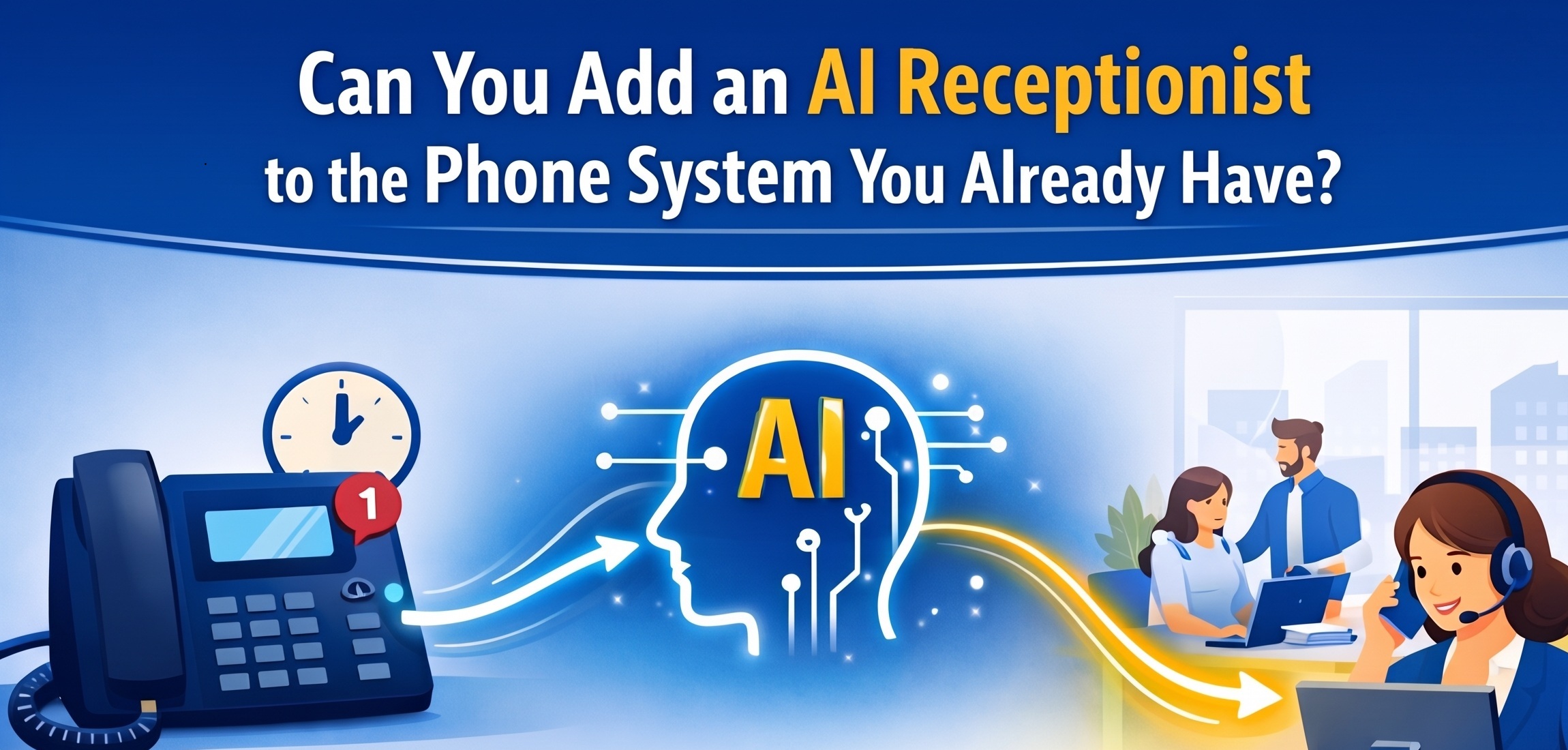
An AI receptionist doesn’t necessarily replace your business phone system. Depending on the system you already have, it can become another part of the way your calls are handled.
Think about the path a call already takes.
A customer dials your business number. Your phone system receives the call and follows the rules you’ve created for where that call should go. Maybe it rings the front desk. Maybe the caller chooses from a menu. Maybe it goes directly to a department or extension.
An AI receptionist gives you another possible stop along that path.
It can answer before the call ever reaches an employee. It can step in only when nobody answers. It can cover the phones after hours, or handle certain calls while your employees handle others.
Because fixing the 12:15 problem shouldn’t create five new ones at 12:16.
The question isn’t simply, “Can we add AI?”
It’s where should AI answer, and where should a human?
This is where call flow matters.
Your business phone system already has a call flow, even if you’ve never called it that. It’s simply the path an incoming call takes from the moment someone dials your number until a person answers, the caller reaches voicemail, or the call ends.
Behind the scenes, that path might include an auto attendant, extensions, hunt groups, call queues, schedules and routing rules. All telecom-speak for deciding who gets the call, when they get it and what happens if they don’t answer.
AI can be added at different points in that path.
Instead of hearing the traditional “Press 1 for sales, press 2 for service,” callers can simply say what they need. The AI receptionist can answer basic questions and route the call to the appropriate extension, department or call queue.
Maybe you like having a human pick up the phone during business hours. Keep it that way. AI can act as an overflow when the receptionist is already on another call, when a hunt group goes unanswered, or when the front desk temporarily becomes a ghost town at 12:15.
After-hours routing can send calls to an AI receptionist once the office closes. Instead of immediately reaching voicemail, callers can still get basic information, leave details about why they’re calling or be routed according to the rules you’ve established.
Sales calls might go directly to your sales team. Existing customers could be routed to support. Routine inquiries could start with AI. A business doesn’t have to choose one way of answering every call just because that’s how the phone system was originally configured.
And there should always be an escape hatch.
If someone is frustrated, has a complicated question, or simply says, “I need to talk to a person,” the call flow should immediately have somewhere human to go.
AI is particularly good at handling the predictable parts of a phone call. Humans are best when the call stops being predictable.
A good phone system can make room for both.
Back to 12:15.
The receptionist leaves for lunch. Calls still get answered, employees keep doing their own jobs, and nobody gets volun-told for front-desk duty.
And the best part is that the AI receptionist doesn’t need a sandwich.
It simply handles the job you gave it until the humans return.
Adding AI should be about fixing the problem you actually have, without replacing everything that already works or handing you a whole new technology project to figure out along the way.
Your existing phone system, carrier, numbers, SIP connections, call routing and business rules all help determine how an AI receptionist can fit into the picture. That’s the part Diamond Voice handles.
Diamond Voice can look at the phone system you already have, how your calls move through it and where an AI receptionist could actually help. Then we handle the telecom behind the scenes so the technology fits the way your business works, instead of asking your business to work around the technology.
Sometimes that means AI answers first. Sometimes it means overflow, after-hours coverage or a carefully planned handoff to a real person.
You may not need a new phone system at all. AI may simply give the one you already have another way to make sure calls get answered.
Let the technology handle the routine. Let your people handle the people.