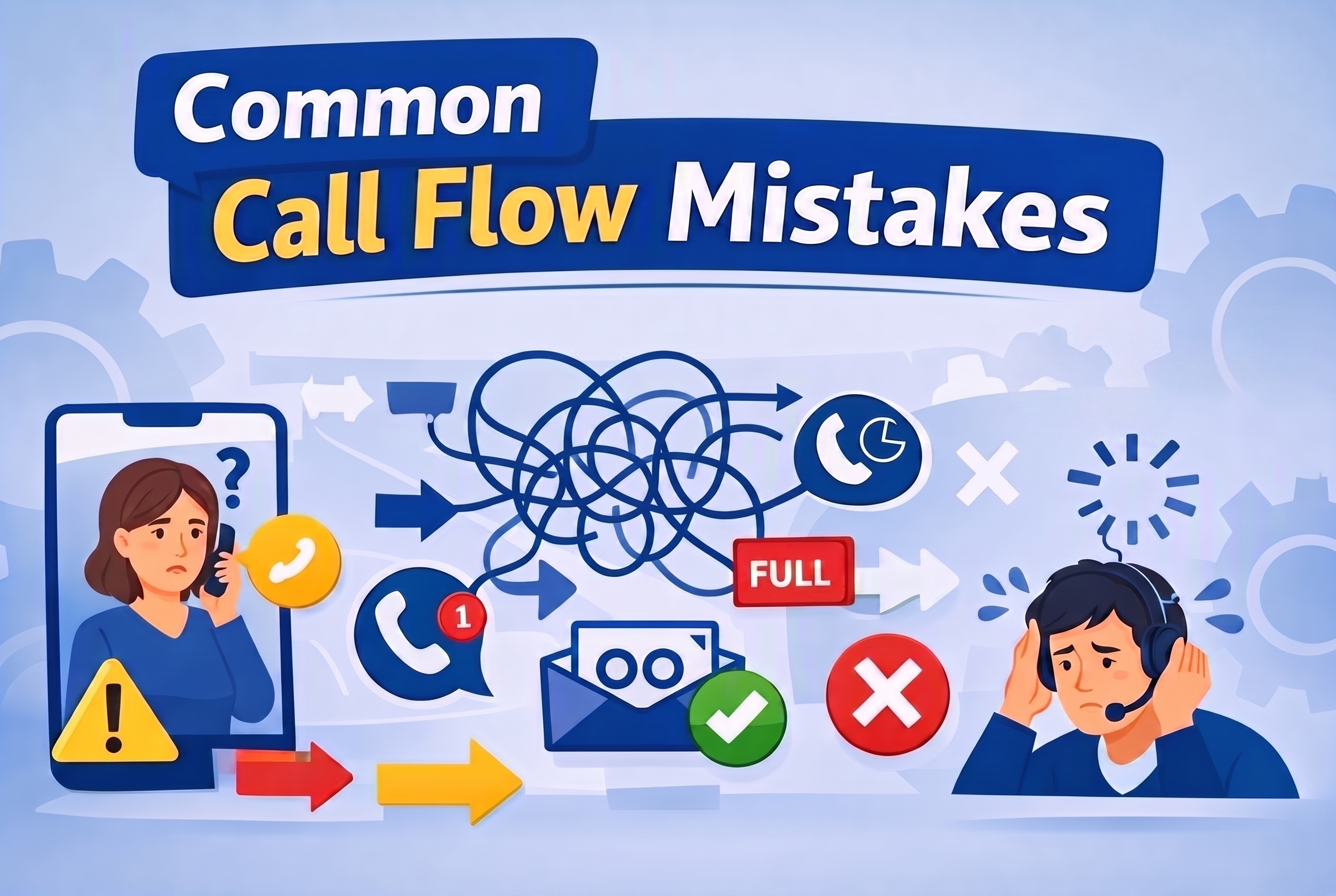
Your phone system is the front door to your business.
But if your call flow isn’t designed right, that door can feel locked, confusing, or downright frustrating to customers.
A “call flow” is simply the path a call takes — from the moment someone dials your number to the moment they reach the right person or voicemail.
And small mistakes in that path can quietly cost you leads, sales, and customer trust.
Let’s look at the seven most common call flow mistakes — and how to fix each one.
Your auto‑attendant lists every department, every extension, and every possible scenario.
By the time callers hear “Press 9 for billing,” they’ve already hung up.
Keep menus short — ideally 3 to 5 options max.
Group related functions (“For Sales, Press 1, for Support, Press 2,…”) and use sub‑menus only when absolutely necessary.
Your goal is clarity, not completeness.
Callers get trapped in loops of recorded messages or voicemail boxes.
They just want to talk to someone — but can’t.
Always include a “Press 0 for a representative” or “Press # (pound) to reach the front desk.”
Even if your business is small, that human option builds trust and prevents frustration.
Your system rings endlessly or dumps calls into a generic voicemail after hours.
That’s a missed opportunity.
Set up a professional after‑hours greeting that includes:
- Your business hours
- Emergency contact info (if applicable)
- A promise of follow‑up (“We’ll return your call first thing tomorrow”)
Bonus: Route urgent calls to a dedicated voicemail box or on‑call number.
Calls bounce between extensions, hunt groups, and voicemail boxes.
Customers hear multiple rings, transfers, and delays.
Simplify.
Map your call flow visually — start to finish — and remove unnecessary hops.
Use time‑based routing (business hours vs. after hours) and priority rules (sales first, support second) to streamline the experience.
Some employees have full voicemail boxes, others have none, and messages go unanswered.
Standardize voicemail greetings and ensure every box is monitored.
Use shared inboxes for departments and voicemail-to-email forwarding so messages never get lost.
You don’t know how many calls you miss, how long customers wait, or which menu options get used most.
Enable call analytics through your VoIP provider.
Track metrics like:
- Missed calls
- Average ring time
- Abandon rate
- Peak hours
Then adjust your call flow based on real data — not guesswork.
Your greeting still says “Happy Holidays 2022” or lists employees who no longer work there.
Review all recordings quarterly.
Update greetings for clarity, tone, and accuracy.
Use a professional voice or consistent brand tone — it’s the first impression customers hear.
A well‑designed call flow doesn’t just route calls — it builds relationships.
Every second of that experience tells customers how organized, responsive, and professional you are.
Fixing these seven mistakes can instantly improve answer rates, reduce frustration, and make your phone system feel like an extension of your brand — not a barrier to it.